12 minute read
Chests of drawers: size, stability and the federal rule
Tall against wide, how drawer count changes what you can fold, and exactly what 16 CFR part 1261 requires of a dresser sold in the United States.
Guide
A hallway is the smallest room most houses have and the one asked to hold the most. Here is how to put a season of shoes in it without losing the walkway.
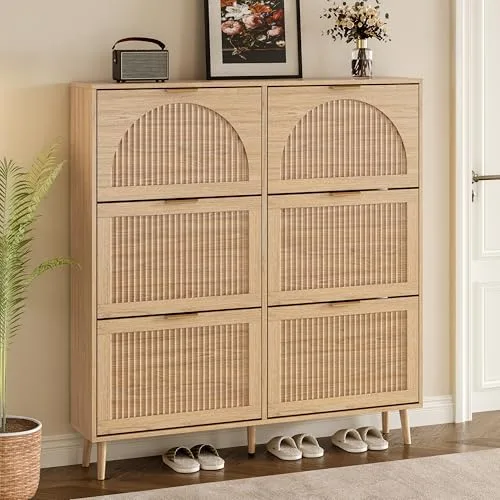
Every hall has the same argument going on in it. On one side, the shoes that come off at the door and never make it upstairs. On the other, the fact that two people have to get past each other while one of them is carrying shopping.
Building regulations are not much help here, because a hallway that is legal to walk down is not the same as a hallway that is pleasant to walk down. The number that matters in practice is what is left after the furniture goes in. Below about 30 inches of clear walkway, two people passing becomes a negotiation. Below about 24, one person with a bag has to turn sideways.
So the real question is not how big a shoe cabinet you can afford. It is how many inches of depth your hall can lose. Everything else follows from that.
| Hall width | Cabinet depth | Walkway left | How that feels |
|---|---|---|---|
| 36 in | 9 in | 27 in | One person, sideways with bags. |
| 40 in | 9 in | 31 in | Comfortable for one, tight for two. |
| 44 in | 12 in | 32 in | Works. This is the common case. |
| 48 in | 14 in | 34 in | Two people pass without thinking. |
| 60 in | 16 in | 44 in | Room for a bench as well. |
Take the width of the hall at its narrowest point, not at the door. Subtract the walkway you want to keep. What remains is the maximum depth of any piece of furniture that hall can hold. In most terraced and apartment halls that number lands between 9 and 14 inches, which is precisely why the tilt-forward shoe cabinet exists.
An ordinary cabinet with shelves has to be deep enough for a shoe to sit flat, which means at least 12 inches inside and closer to 14 once you add the carcass. A pull-out drawer needs all of that plus the same distance again in front of it, so it can open.
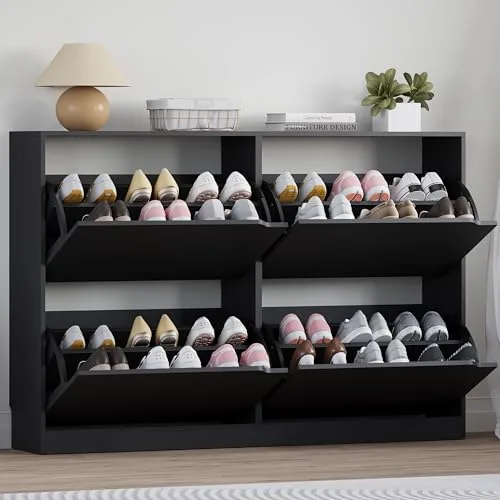
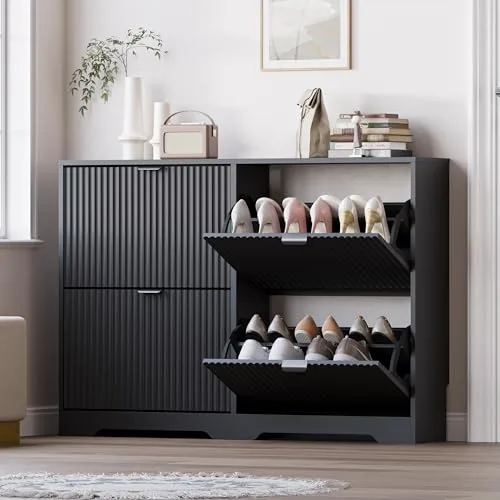
The tilt-forward drawer solves both at once. The front panel is hinged at the bottom and swings out and down. The shoes sit inside it at an angle, toe down, heel up, resting against an internal panel. When the front is closed the shoes are held at that angle inside a box that only needs to be deep enough for the diagonal, not for the whole shoe.
In our range that arithmetic produces cabinets between 9.2 and 9.6 inches deep. Compare that with a chest of drawers, where the shallowest piece we publish is still 9.2 inches. The tilt is worth about a third of the depth, and in a hall a third of the depth is the difference between a cabinet and no cabinet.
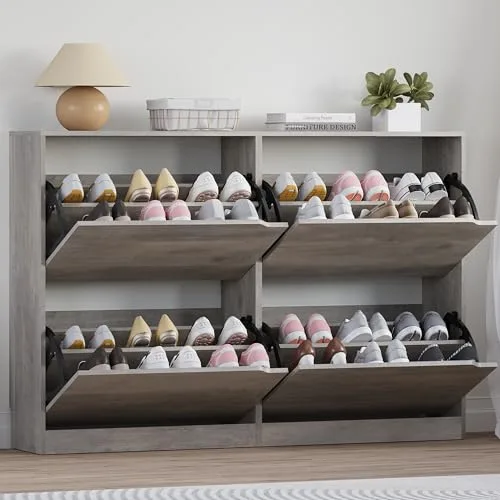
There are two costs. The first is that a tilted drawer holds shoes in a fixed posture, so tall boots and stiff walking boots often will not go in at all. The second is clearance. The front panel swings into the hall as it opens, typically about as far as the cabinet is tall in that section. It takes back the depth you saved, but only while you are using it.
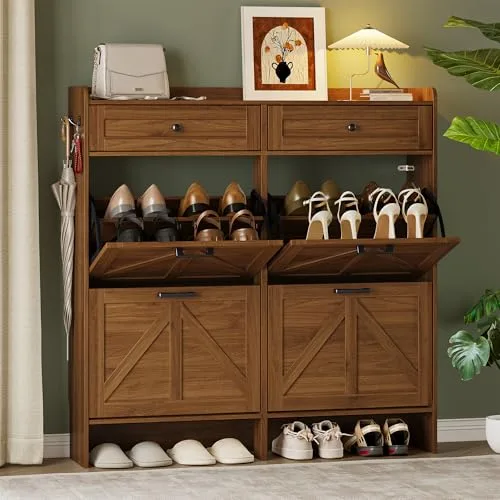
Shoe cabinets are sold on a number of pairs, and the number is always a range. Ours run from 6 to 36 pairs across 56 cabinets that publish a figure. It is a range because the honest answer depends on what is in your hall.
A pair of low trainers occupies about half the vertical space of a pair of ankle boots. A cabinet rated for 18 to 24 pairs is telling you that 24 is achievable with flats and trainers and 18 is realistic with a normal mix. Neither number assumes a household of walking boots.
The useful way to read a range is to take the lower figure as the one you will actually live with, and the upper as what is possible in a hall of summer shoes. If the lower figure covers what you own, the cabinet works all year.
| Cabinet | Published pairs | Depth | Height |
|---|---|---|---|
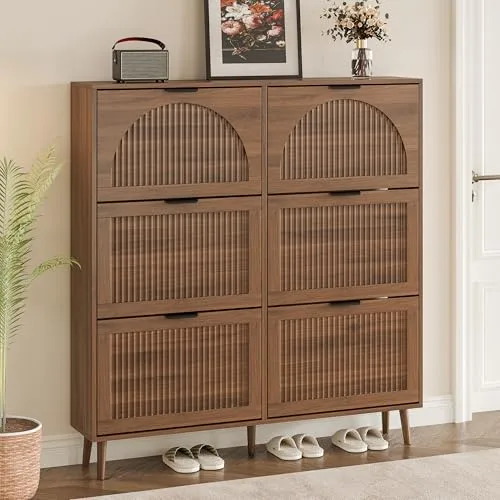
| Fluted Slim 6-Flip Shoe Cabinet, 50.4 in Tall, Oak | 6 to 8 | 9.3 in | 50.4 in |
| Farmhouse Slim 2-Flip Shoe Cabinet, 42.7 in Tall, Black | 16 to 20 | 9.3 in | 42.7 in |
| 3-Flip Shoe Cabinet, 47.2 in Tall, Pink | 18 to 24 | 9.5 in | 47.2 in |
| Fluted Slim 6-Flip Shoe Cabinet, 50.4 in Tall, Black | 24 to 36 | 9.3 in | 50.4 in |
You can also work the problem backwards. The hall arithmetic tool on our home page takes the number of people and the pairs each of them keeps downstairs, and lists the cabinets whose own published range covers the total. It does not estimate. It only ever reports what a cabinet says about itself.
Inside each tilting drawer there is usually a panel that sets the angle and divides the drawer into two tiers. On most cabinets in our range it sits in a pair of grooves and can be moved or taken out entirely.
That small piece of board decides what the cabinet is for. With the panel in, you get two shallow tiers per drawer and the highest pair count. With it out, you get one tall slot per drawer, the pair count roughly halves, and a mid-height boot fits.
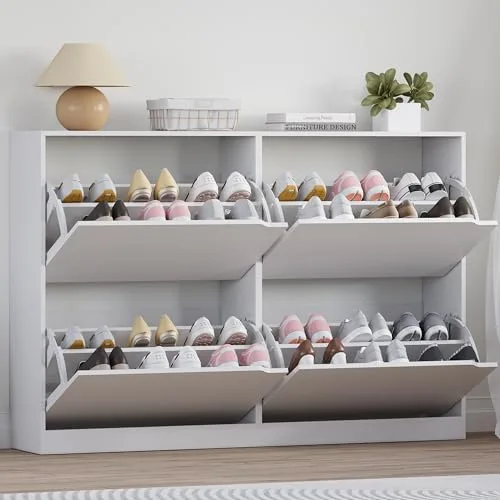
Most halls end up mixed: panels in on the upper drawers for everyday shoes, panels out at the bottom for boots. It is worth checking before you order whether the model you are looking at has removable panels, because the ones that do not are locked into one answer.
44 of our 65 shoe cabinets state adjustable or removable inner shelving. The rest have fixed shelves, and each product page says which.
Three extras turn up in this category and each solves a real problem.
A bench top rated to sit on changes how the hall is used. Putting boots on standing up is where people fall over, and a hall with somewhere to sit is a hall where shoes actually get put away. Eight cabinets in our range carry one.
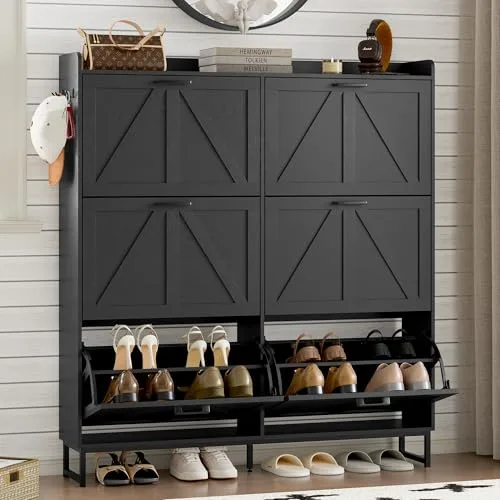
An odour control panel in the back is not a gimmick. A closed cabinet full of shoes that have been worn all day, standing next to a radiator, is a specific problem. Nine of ours state some form of odour control or ventilated back panel.
The top surface matters more than it looks. A shoe cabinet is at hip height, right by the door, which makes it the natural landing place for keys, post and a lamp. A cabinet with a lipped or trimmed top keeps those things on it. A flat top is tidier to look at and lets a set of keys slide off behind.
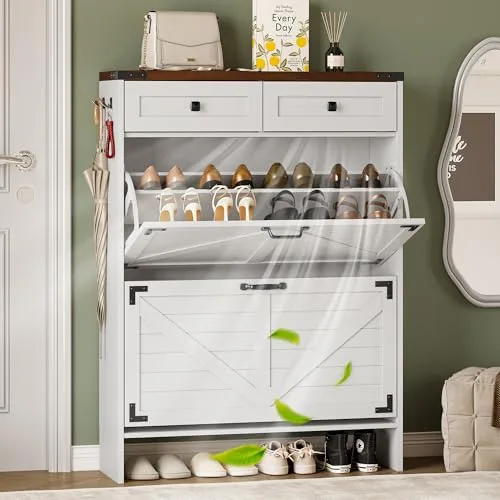
The measurement that catches people out is not the cabinet, it is everything that swings. A hall usually has three moving things in it: the front door, an internal door, and the cabinet itself. Any two of them wanting the same air at the same time is a daily irritation rather than a one-off problem.
Start with the front door. A door on a standard hinge sweeps a quarter circle with a radius equal to its own width, and most front doors are around 32 to 36 inches. Furniture inside that arc gets hit, and the damage always lands on the same corner.
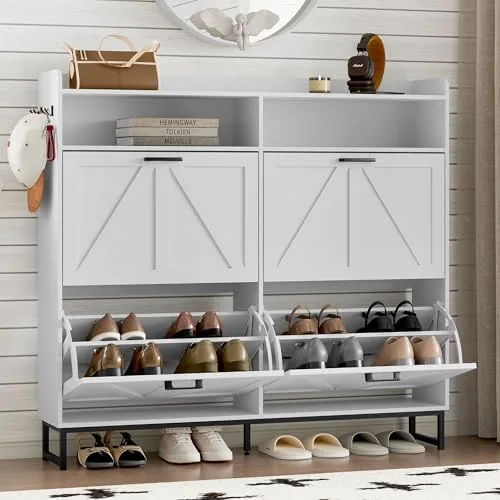
Then the cabinet. A tilting front swings down and out, and the distance it reaches from the carcass is roughly the height of that one drawer section. On a three-drawer cabinet, each section is about a third of the cabinet height, so a 47 inch cabinet needs somewhere near 16 inches of clear floor in front of an open drawer. That is temporary, and it is the moment you are standing there with one shoe on.
Two arrangements avoid the argument entirely. Put the cabinet on the wall behind the door swing, so the door opens across it rather than into it. Or, in a hall too narrow for either, choose a doored cabinet with internal shelves instead of tilting drawers, and accept the extra depth in exchange for a door that opens flat against the wall.
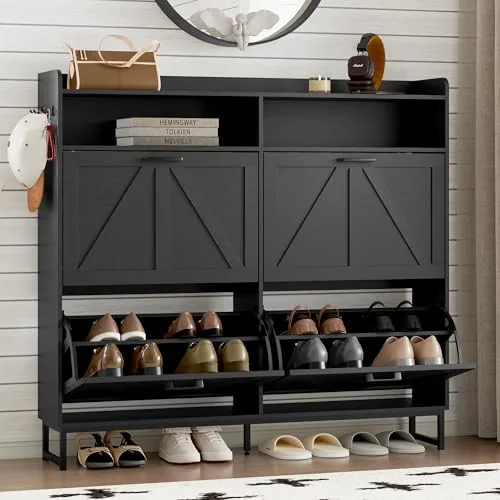
One more thing worth checking before you order: how the cabinet is handed. Several of ours have a fixed opening direction on the bench or top section, and in a hall with a wall on one side only, that decides which end of the hall the piece can live at.
Halls have the worst floors in the house. They are the oldest surface, the most walked on, and in older homes they are frequently the least level. That matters more for a tall shallow cabinet than for anything else you own.
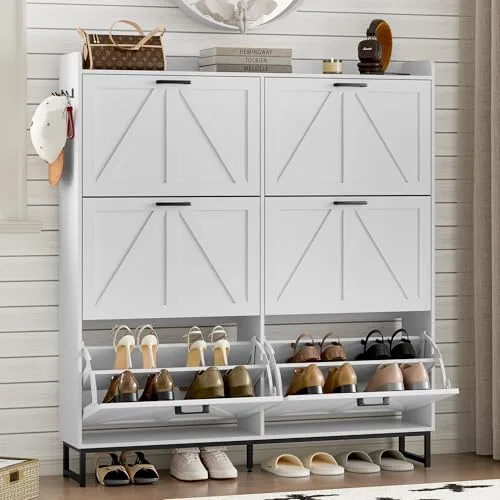
A cabinet with a small footprint amplifies a sloping floor. A quarter inch of fall across 12 inches of depth tilts the whole carcass, and on a piece four feet tall the top edge moves noticeably away from the wall. Once it is tilted, the drawer fronts stop lining up and the doors stop sitting flush, and every attempt to fix that at the hinge makes it worse.
The fix takes five minutes at assembly. Stand the empty carcass in position, put a spirit level on the top, and shim the low feet until the bubble sits centred both ways. Do it before anything goes inside, because a loaded cabinet is much harder to lift and much easier to twist.
The wall has its own problem. Almost every room has a skirting board that stands proud of the plaster, typically half an inch to an inch. A cabinet with a flat back sits that far into the hall whether you like it or not, and in a corridor where you have just fought for every inch of depth, an unexpected inch is a real loss. Measure to the front face of the skirting, not to the wall behind it.
If the cabinet is going to be anchored, and a tall one in a hall should be, the anchor has to reach something structural. Plasterboard alone will not hold a loaded cabinet that has started to rotate. Find the stud, or use a fixing rated for the board you actually have.
A hall cabinet is tall, narrow front to back, and gets pulled forward every time a drawer is opened. It is the classic tip-over geometry, and it lives in the part of the house where children take their shoes off.
The federal standard for tip-over, 16 CFR part 1261, does not cover it. The Consumer Product Safety Commission scopes that rule to clothing storage units, meaning free-standing furniture with drawers or hinged doors intended for storing clothing typical of bedroom furniture, at least 27 inches tall, at least 30 pounds, and enclosing at least 3.2 cubic feet. A hall shoe cabinet is not bedroom clothing storage, so it has not been through the three stability tests that rule requires.
That is an argument for anchoring it yourself, not for relaxing. The Commission's tip-over campaign asks you to anchor top-heavy furniture to the wall and to fit the supplied anti-tip device straight away. It also asks you to keep the things children climb for off the top.
65 of our 65 hall cabinets state anti-tip hardware in the box. Fitting it takes about five minutes while the cabinet is empty and is a genuinely awkward job once it is full and against a wall.
Sources: U.S. Consumer Product Safety Commission, Clothing Storage Units: business guidance (read 8 August 2026). U.S. Consumer Product Safety Commission, AnchorIt.gov, the tip-over prevention campaign (read 8 August 2026).
The order below works because each step removes options rather than adding them, and the first step is the one that cannot be argued with.
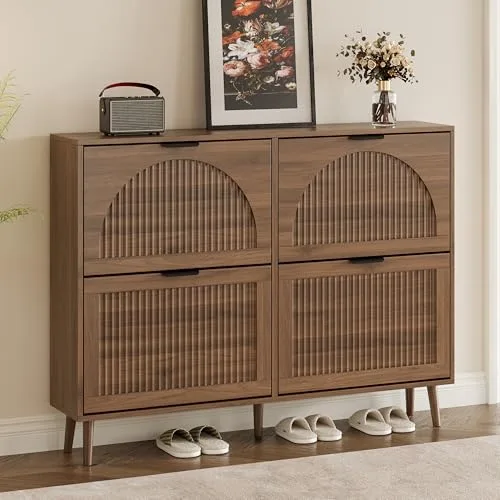
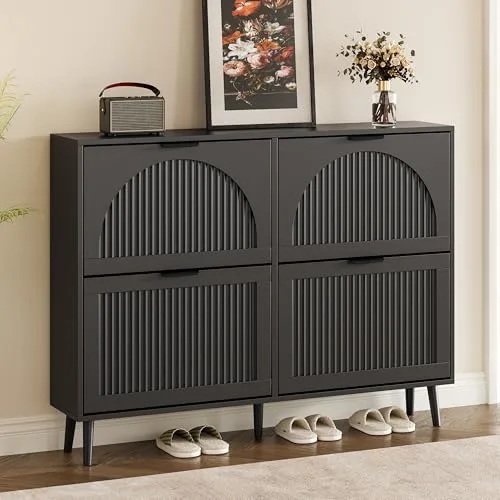
Our shoe cabinet department lists all 65 of them with the depth in the name, so the first filter is the fastest one. If the hall genuinely has no depth to give, a console table at 11.8 inches deep with baskets underneath is the narrower answer.
12 minute read
Tall against wide, how drawer count changes what you can fold, and exactly what 16 CFR part 1261 requires of a dresser sold in the United States.
11 minute read
Why reeded furniture reads quietly in a small room, how to match a finish to a floor rather than a wall, and what composite wood means for the way a piece ages.