11 minute read
Shoe storage that fits a narrow hall
How deep a hall cabinet can be before it ruins the hall, what published pair counts really mean, and the six measurements to take before ordering.
Guide
A chest of drawers is the one piece of storage furniture in your house with a federal safety standard written specifically for it. This is what the standard says, and how to choose within it.
Every chest of drawers is a compromise between floor area and height, and the right answer is set by the wall you have rather than by how much you want to store.
A tall chest stacks drawers vertically on a small footprint. In our range the narrow ones start at 23.6 inches wide, which fits between a door and a window in a bedroom where nothing else will. The cost is that the top drawer ends up above shoulder height on a tall unit, and that anything on top of it is out of reach and out of sight.
A wide chest spreads the same capacity across a longer wall, up to 63 inches here. You get a working surface at hip height, which is what most people actually want under a mirror or a television. The cost is a long clear wall, which small bedrooms rarely have.
There is a third consideration that gets missed. A tall chest with all its weight in the top drawers is a tip-over risk in a way a wide chest is not. The physics is not subtle: raising the centre of gravity and shrinking the base does exactly what you would expect.
| Group | Pieces | Drawers | Height (in) | 27 in or taller |
|---|---|---|---|---|
| Narrow, under 28 in | 13 | 3 to 5 | 29.5 to 45.5 | 13 |
| Standard, 28 to 48 in | 29 | 4 to 10 | 29.5 to 48.8 | 29 |
| Wide, over 48 in | 22 | 6 to 12 | 30 to 40 | 22 |
Our chests run from 3 to 12 drawers. A higher number is not more storage. At a fixed height and width, it is the same volume cut into more slices.
That matters because folded clothes are not all the same thickness. Socks and underwear want shallow drawers, so a nine-drawer chest is genuinely better for them. A folded jumper is about four inches thick, and a shallow drawer will hold two of them badly rather than four of them well.
The useful habit is to count deep drawers rather than total drawers. Most chests in this range put the deep ones at the bottom, which is also where you want the weight. If a chest has six drawers and two of them are deep, it is a two-jumper-drawer chest with four shirt drawers, and that is the honest way to think about it.
Published data states the drawer count and not the individual drawer depths, so our product pages state the count and stop there. We could divide the height by the number of drawers and present the result as a specification. It would look precise and it would be our arithmetic rather than the maker's measurement.
In 2022 Congress passed the STURDY law, which directed the Consumer Product Safety Commission to write a mandatory safety standard for clothing storage units. The Commission published it, and the requirements are now codified at 16 CFR part 1261. They apply to units manufactured after 1 September 2023.
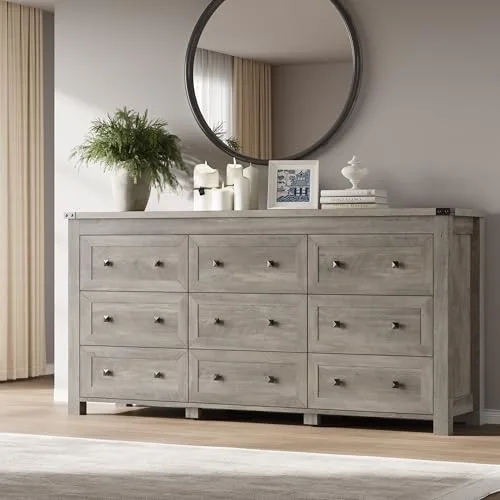
The first thing to understand is the scope, because it is narrower than most people assume. A clothing storage unit, for the purposes of the rule, is a furniture item with drawers or hinged doors intended for storing clothing typical of bedroom furniture, and it has to meet all four of these:
Chests, chests of drawers, drawer chests, armoires, chifferobes, bureaus, door chests and dressers are named as examples. Bookcases, entertainment furniture, office furniture, dining room furniture, jewellery armoires, underbed drawer units and accent furniture not intended for the bedroom are named as outside it.
A unit in scope has to comply with ASTM F2057-23, which is incorporated into the rule by reference. That standard sets three stability tests, and a unit has to pass all three:
On top of the tests, an anti-tip device meeting ASTM F3096 must be packaged with the product, and the warning label has to carry set statements and pictograms.
A free read-only copy of ASTM F2057 can be viewed through the ASTM reading library, which means the test method is something a shopper can actually check rather than take on trust.
Sources: U.S. Consumer Product Safety Commission, Clothing Storage Units: business guidance (read 8 August 2026). Electronic Code of Federal Regulations, 16 CFR Part 1261, Safety Standard for Clothing Storage Units (read 8 August 2026).
We publish the height of every piece in its name for this reason. 98 of our chests and bedside chests stand 27 inches or taller, which is the height threshold in the definition. The other pieces in those departments sit below it.
Across the whole range, 190 of 230 pieces state anti-tip hardware in the box. That is a larger number than the pieces the rule covers, which is the sensible way round.
A page here states the height and the weight the maker gives, and whether anti-tip hardware is named. The certificate for a regulated product is issued by whoever manufactures or imports it, and the citation used on it is the one the Commission specifies.
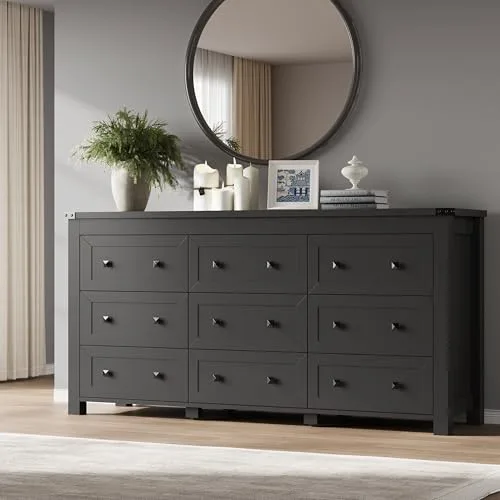
If a piece is a bedroom chest, free standing, over 27 inches, over 30 pounds and over 3.2 cubic feet, the federal stability tests apply to it. If it is a bookcase, a media unit, a desk or a kitchen cabinet, they do not, and anchoring it is entirely down to you.
The Commission has run a tip-over campaign since 2015. Its practical advice is short: anchor top-heavy furniture and televisions, install the anti-tip device that comes with new furniture straight away, follow the maker's instructions, and keep the toys and remote controls children climb for off the top of furniture.
That last point is the one people skip. A child does not climb a chest of drawers because it is there. They climb it because something they want is on top of it.
The mechanics are worth understanding once. An anchor is not holding the weight of the chest. It is stopping the chest rotating about its front feet. That is why a strap into the wall behind the top of the carcass works, and why a bracket fitted low down does almost nothing.
Two conditions decide whether an anchor holds. The fixing has to go into something structural rather than into plasterboard alone, and the strap has to be tight enough that the chest cannot get any rotational momentum before it comes taut. Both take about five minutes while the chest is empty and are considerably harder once it is full and pushed back against a wall.
Sources: U.S. Consumer Product Safety Commission, AnchorIt.gov, the tip-over prevention campaign (read 8 August 2026).
The tip-over statistics that produced the STURDY law are about children, and a chest of drawers in a child's room is the piece the whole standard was written around. Three decisions matter more here than anywhere else in the house.
Choose low and wide over tall and narrow. The stability tests exist because a tall chest with a heavy open drawer wants to rotate about its front feet. A wide chest has a longer base and a lower centre of gravity, and it is doing less of that from the start. In our range the wide group runs to 63 inches, and it is the safer geometry as well as the more useful surface.
Anchor it, and anchor it on the day. The Commission's campaign is blunt about this: the device that comes with new furniture should go on straight away rather than at some later date. The reason is behavioural rather than technical. Everybody intends to fit it later and a full chest pushed against a wall is a genuinely awkward job.
Put nothing on top that a child wants. A chest is not climbed because it is climbable. It is climbed because the thing a four-year-old wants is on top of it. Televisions, toys and remote controls on top of a chest are the specific arrangement the campaign asks people to undo.
One more that is easy to forget: drawers themselves are the ladder. A chest with all its drawers closed is stable in a way that a chest with three drawers open is not, and a child opening drawers to climb them is exactly the scenario the carpet test with the 60 pound weight is simulating. Interlocks that allow only one drawer open at a time exist for this, and where a piece has them the standard has rules about how they must behave.
Sources: U.S. Consumer Product Safety Commission, AnchorIt.gov, the tip-over prevention campaign (read 8 August 2026). U.S. Consumer Product Safety Commission, Clothing Storage Units: business guidance (read 8 August 2026).
Almost every complaint about a chest of drawers after the first year describes the same symptom: the drawers have stopped closing flush. One sits proud at a corner, or two of them rub. It reads like a manufacturing fault and it is nearly always a loading story.
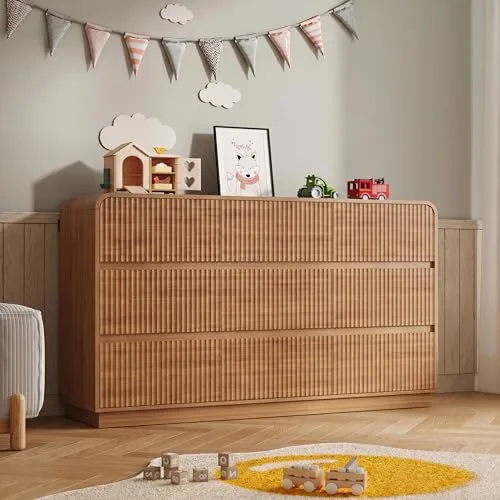
A carcass is a box held square by its back panel and its joints. Pulling a heavy drawer out moves a large mass forward of the front feet, and the box resists that by twisting a fraction. Do it a few thousand times with the weight up high and the twist stops being temporary. The technical name is racking, and once a carcass has racked, nothing at the hinge or the runner will bring the fronts back into line.
Three habits prevent it entirely. Load the bottom drawers first and keep them the heaviest. Do not use the top drawer for books, tools or anything else dense. And do not lean on an open drawer, which applies the same force with a person's weight behind it.
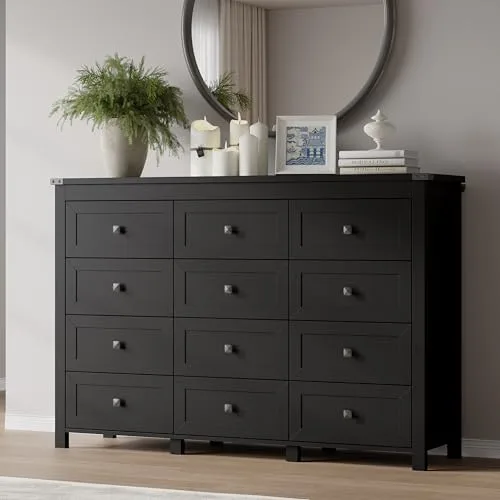
The other half of the problem is the floor. A chest on an uneven floor is already twisted before anything goes in it, so shim the feet at assembly and check with a level across the top in both directions. Adjusting a hinge to compensate for a floor is a repair that lasts about a fortnight.
If a chest has already racked, the honest answer is that it can sometimes be improved by emptying it, standing it square, re-tightening every fixing including the back panel, and levelling the floor underneath. It rarely comes all the way back, and that is the argument for the five minutes at assembly over any repair afterwards.
Two things decide whether a chest still feels good in three years: what the drawers run on, and how the carcass is loaded.
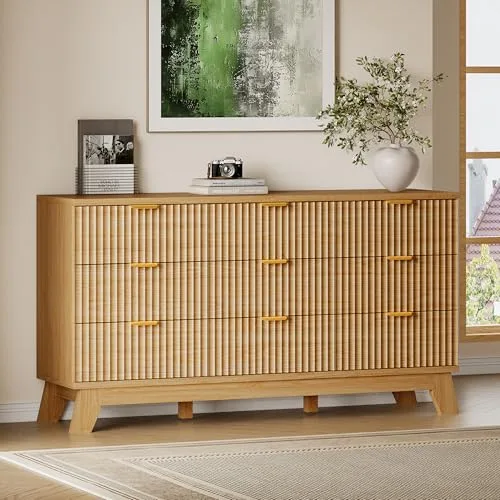
18 of our chests state metal drawer slides. Metal slides matter most on wide drawers, where a wooden runner has the furthest to go before it starts to bind.
Loading is the part under your control. Heavy things in the bottom drawers keeps the centre of gravity low and stops the carcass racking every time the top drawer comes out. A chest that has developed a twist is a chest whose drawers have stopped closing flush, and that is almost always a loading story rather than a manufacturing one.
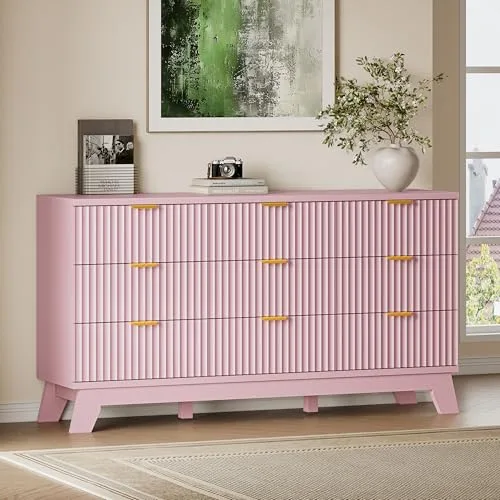
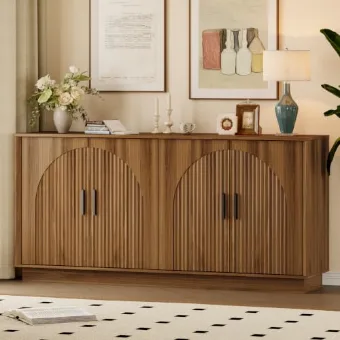
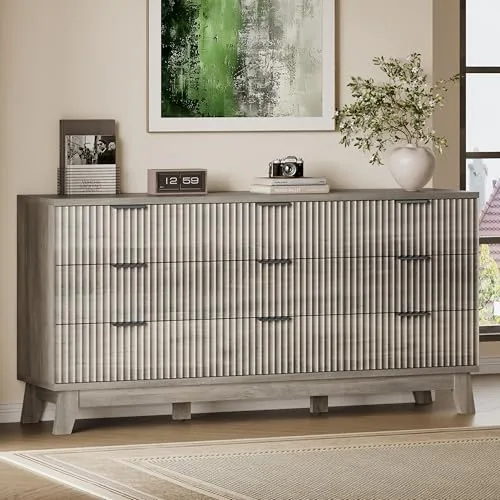
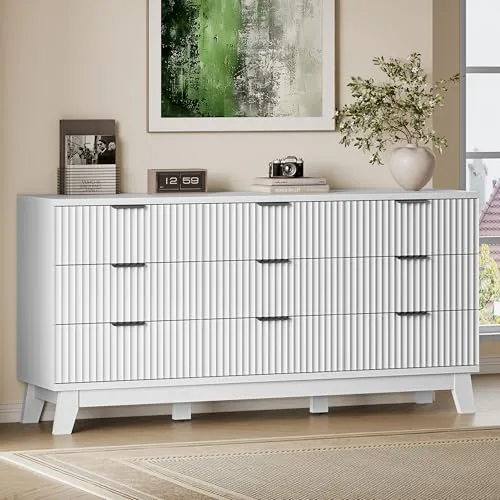
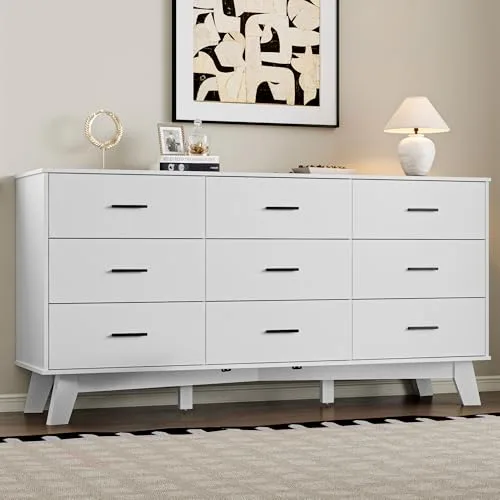
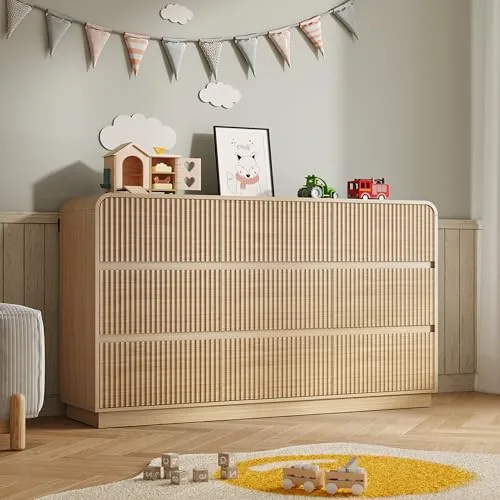
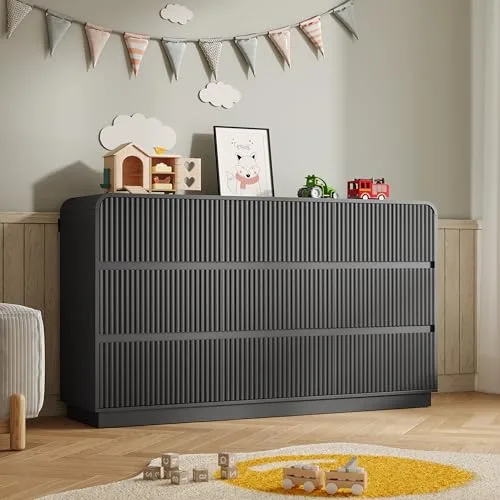
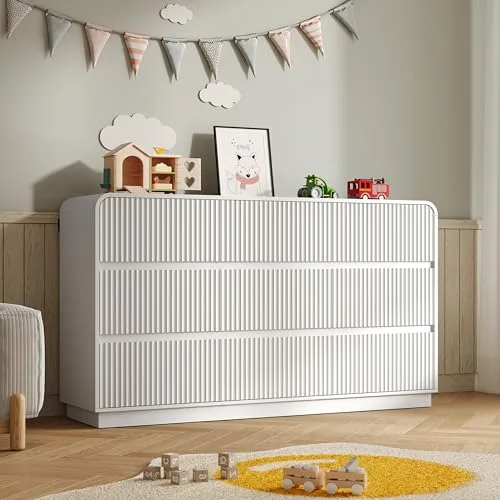
On fronts, 28 of our chests carry a reeded face and 28 carry rounded corners or a curved edge. A reeded front on a wide chest hides the drawer gaps, so a nine-drawer piece reads as a single object rather than as a grid. Hidden cutout handles push that further and are harder to open with an armful of laundry, which is a fair thing to weigh.
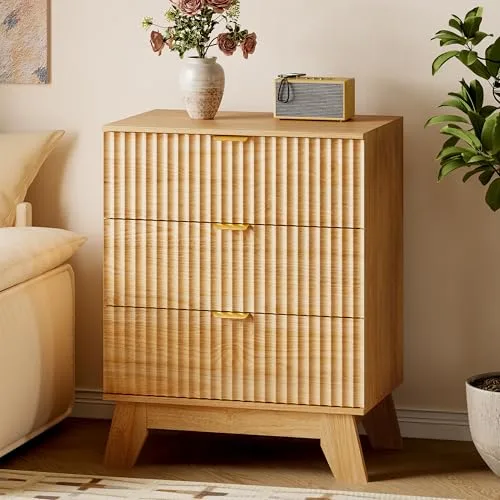
All 64 chests are in the dressers department, with the width and drawer count in each name. If the wall is short and the room is not, a pair of bedside chests either side of a bed sometimes solves the same storage problem with better proportions.
11 minute read
How deep a hall cabinet can be before it ruins the hall, what published pair counts really mean, and the six measurements to take before ordering.
11 minute read
Why reeded furniture reads quietly in a small room, how to match a finish to a floor rather than a wall, and what composite wood means for the way a piece ages.